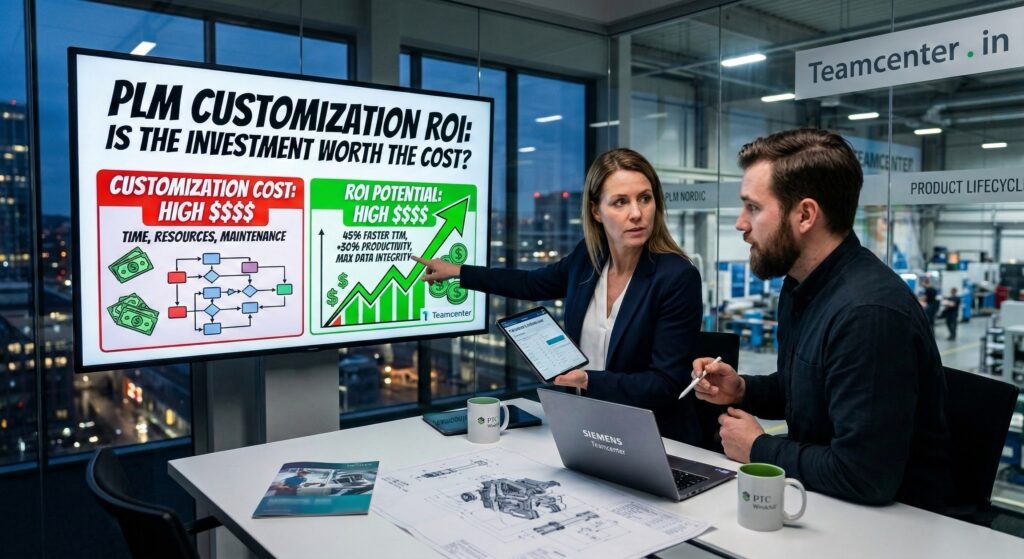

In the current industrial landscape, Product Lifecycle Management (PLM) systems have evolved from simple data repositories into the “single source of truth” for the enterprise. Platforms like Siemens Teamcenter, PTC Windchill, and Enovia orchestrate complex product data across global teams. However, one question dominates the boardroom during implementation: Is PLM customization worth the investment?
Choosing between Out-of-the-Box (OOTB) functionality and a deeply customized environment is a high-stakes decision. Below, we break down the strategic value, technical challenges, and the ultimate ROI of tailoring your PLM landscape.
The Strategic Value of PLM Customization
1. Precision Alignment with Proprietary Business Logic
No two manufacturing workflows are identical. While OOTB solutions provide a solid foundation, customization allows you to embed your organization’s unique Intellectual Property (IP) into the system architecture. By utilizing the Business Modeler IDE (BMIDE) to create custom data schemas or specialized workflows, you eliminate the friction of “forcing” your engineering processes into a generic software mold.
2. Driving User Adoption through UI/UX Optimization
One of the primary causes of PLM failure is poor user adoption. Standard interfaces can often be cluttered with irrelevant fields. Customizing the user experience—specifically through modern frameworks like Active Workspace—allows you to present role-specific data. When the system mirrors the user’s actual daily tasks, adoption rates increase, leading to higher data integrity and cross-functional collaboration.
3. Gaining a Competitive Edge in Time-to-Market
In high-velocity industries, speed is a critical KPI. A customized PLM system acts as a force multiplier. By automating repetitive tasks and building proprietary integrations between PLM and downstream systems (like ERP or MES), companies can respond to market shifts faster than competitors who are restricted by standard software limitations.
4. Automated Data Integrity and “Digital Thread” Quality
Manual data entry is a significant risk factor in engineering. Tailored PLM solutions allow for advanced data validation rules and automated “gate-keeping.” This ensures that CAD data and BOM metadata meet rigorous standards before progressing through the lifecycle, significantly reducing the cost of downstream manufacturing errors.
Technical Challenges and Long-Term Risks
While the benefits are substantial, engineering leaders must account for the following technical hurdles:
- Initial Capital Expenditure (CapEx): Customization requires a higher upfront budget for software development, specialized consultancy, and architectural planning.
- The Upgrade Complexity Trap: A common concern is that custom code might “break” during major software version upgrades. To mitigate this, developers must follow best practices, such as using Service Oriented Architecture (SOA) or supported APIs (ITK/RAC), to ensure the system remains “upgrade-friendly.”
- Technical Debt and Maintenance: Every line of custom code requires ongoing maintenance, including performance tuning and bug fixes as your infrastructure evolves.
Decision Framework: Evaluating the ROI
To determine if PLM customization is a viable investment for your organization, use the following evaluation criteria:
Conduct a Gap Analysis
Map your current “as-is” processes against the “to-be” capabilities of the OOTB software. If the standard software forces you to compromise on your core value proposition or creates significant manual workarounds, customization is no longer optional—it is a necessity.
Quantify the Productivity Gains
Calculate the potential savings in man-hours by automating manual data transfers or simplifying complex approval workflows. If the projected 3-year ROI (derived from reduced error rates and faster production cycles) exceeds the cost of development and maintenance, the investment is technically sound.
Scalability and Architecture
Ensure that any customization is built with scalability in mind. A high-value PLM environment must be able to handle a 5x increase in users or a 10x increase in data volume without performance degradation.
Final Verdict: Balancing Customization and Stability
PLM customization is a high-value investment for organizations that view their product development process as a strategic differentiator. While the challenges of cost and maintenance are real, the long-term benefits of a high-performance, tailored digital thread often far outweigh the risks.
The most successful implementations strike a balance: Standardize where possible, and customize where it creates value.